Category: Death Registration

  • Electronic Transfers vs. Paper MCCDs: Why the Registrar Will Turn You Away If You Bring a Paper Form

    Electronic Transfers vs. Paper MCCDs: Why the Registrar Will Turn You Away If You Bring a Paper Form

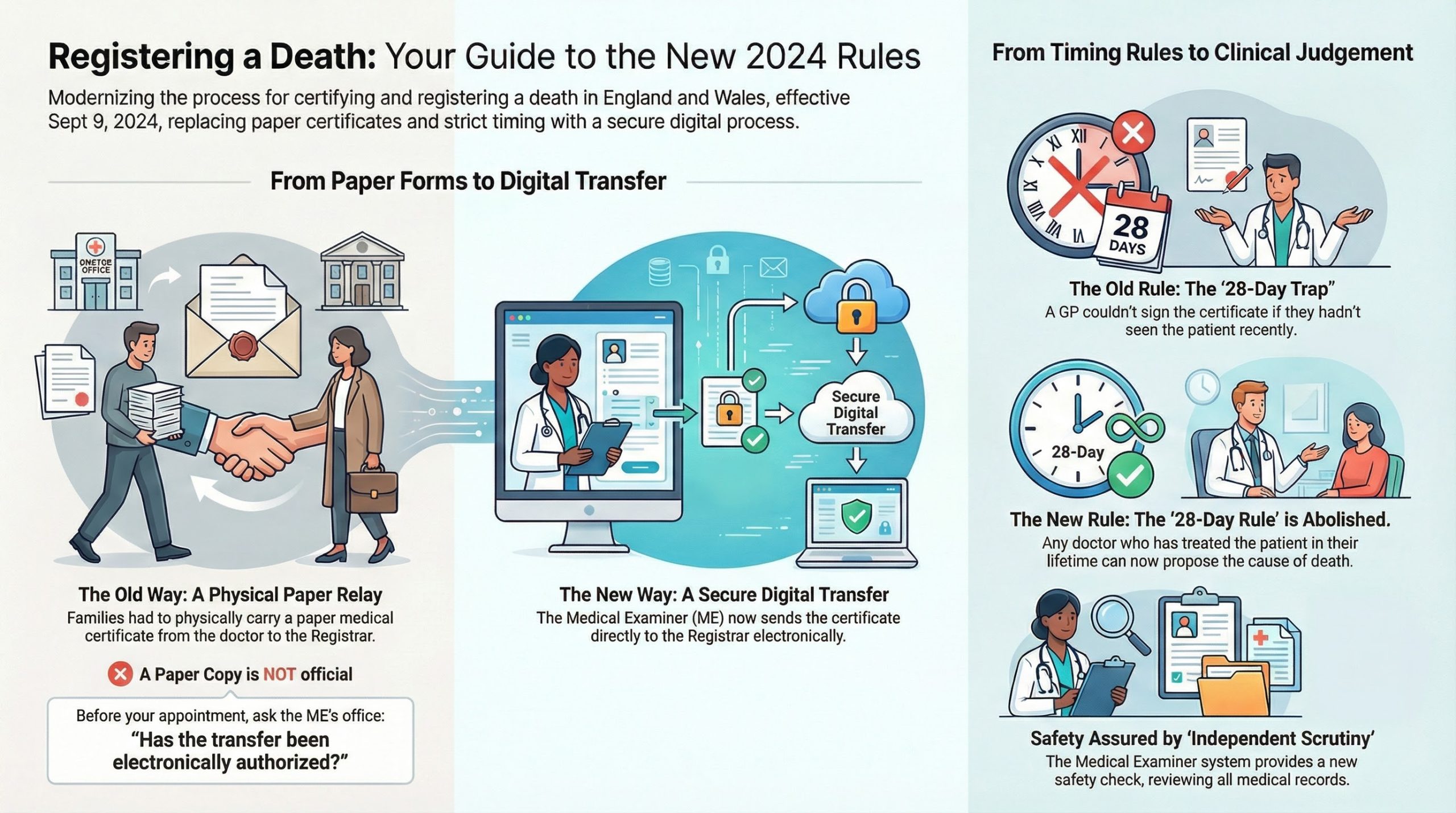
    For decades, the “Green Form” and the “Medical Certificate of Cause of Death” (MCCD) were physical talismans. Grieving families would wait at a GP surgery or hospital bereavement office, be handed an envelope, and physically carry that paper to the Register Office. It was a tangible, albeit heavy, part of the process.

    As of September 9, 2024, that physical relay has been legally abolished.

    If you arrive at a Register Office today holding a paper MCCD given to you by a doctor, you are likely to be turned away. This guide explains the technical logic of the new Electronic Transfer system and how to ensure the “digital baton” has been passed before you leave your house.

    1. The “Paper Draft” Trap

    One of the most common points of friction in the new system occurs when a doctor or hospital staff member prints out a “copy” of the MCCD for the family. While this is helpful for your records, it has no legal standing at the Register Office.

    The Technical Reality: Under the Medical Certificate of Cause of Death Regulations 2024, the Registrar is prohibited from registering a death based on a paper document presented by the family. They can only proceed once they receive a secure, encrypted electronic notification directly from the Medical Examiner’s (ME) office.

    2. The “Scrutiny Complete” Flag

    The reason for this digital-only approach is the mandatory scrutiny phase. In the old system, the GP’s signature was the final word. In the new system, the process looks like this:

    1. The Doctor drafts the MCCD digitally.
    2. The Medical Examiner reviews the digital file and performs “Independent Scrutiny.”
    3. The Family Discussion takes place via a Medical Examiner Officer (MEO).
    4. The ME Digital Signature: Once the ME is satisfied, they click “Authorize.” This sends the file through a national portal directly to the Registrar in the district where the death occurred.

    If you have the paper but the ME hasn’t clicked “Authorize,” the Registrar literally cannot see the death on their screen. To them, the person hasn’t officially “passed through the system” yet.

    3. Why the Registrar Will Turn You Away

    Registrars now operate on an appointment-only basis with very tight windows. If you book an appointment and turn up with a paper form, but the digital transfer hasn’t arrived, the Registrar cannot:

    • Verify the cause of death.
    • Issue the “Green Form” for the funeral.
    • Issue the official Death Certificates.

    This results in wasted time, increased family distress, and the need to re-book—often days later. This is a failure of “Unreasonable Hospitality” in the public sector, but you can avoid it by knowing the digital status.

    4. How to Verify the Digital Transfer

    To ensure you aren’t walking into a “Registration Trap,” follow these steps before your appointment:

    • Ask the “Authorization” Question: Don’t ask the GP if the form is “ready.” Ask the Medical Examiner Officer: “Has the Medical Examiner electronically authorized the transfer to the Registrar yet?”
    • Wait for the Email/SMS: Many Medical Examiner offices now send an automated notification to the family once the electronic transfer is successful.
    • The “Register by Declaration” Exception: If you are registering a death in a different city (by declaration), the electronic transfer must still go to the original district first, which then coordinates with your local office. This adds an extra digital layer that requires verification.

    5. Frequently Asked Questions (FAQ)

    Q: Can I email a scan of the paper MCCD to the Registrar? A: No. The Registrar will only accept the version sent via the secure NHS/General Register Office (GRO) portal.

    Q: What if the doctor says they “don’t do” electronic transfers? A: All GP surgeries and hospitals in England and Wales are now required to use this system. If they are refusing, they are in breach of the 2024 regulations.

    Q: Does this apply to Coroner cases? A: No. If the Coroner is involved, they use a different form (Form 100) which is also sent electronically to the Registrar, but the workflow bypasses the standard Medical Examiner route.

    Expert Summary

    The shift to digital is designed to prevent fraud and errors, but it has removed the “tangible” certainty of holding the paperwork. As an Executor, your new “baton” is the confirmation of a digital transfer.

    Before you step foot in a Register Office, ensure the digital handshake between the ME and the Registrar has been completed. For further support in coordinating the first family meeting after these hurdles are cleared, you can find resources at the Sunday Roast Forecaster.

    Next Step: Once the digital transfer is confirmed, your next hurdle is the registration appointment itself. Use our 72-Hour Limbo Checker to monitor the status of your case in real-time.
  • The “Attending Practitioner” Myth: Why Any Doctor Who Treated Your Loved One Can Now Sign the MCCD

    The “Attending Practitioner” Myth: Why Any Doctor Who Treated Your Loved One Can Now Sign the MCCD

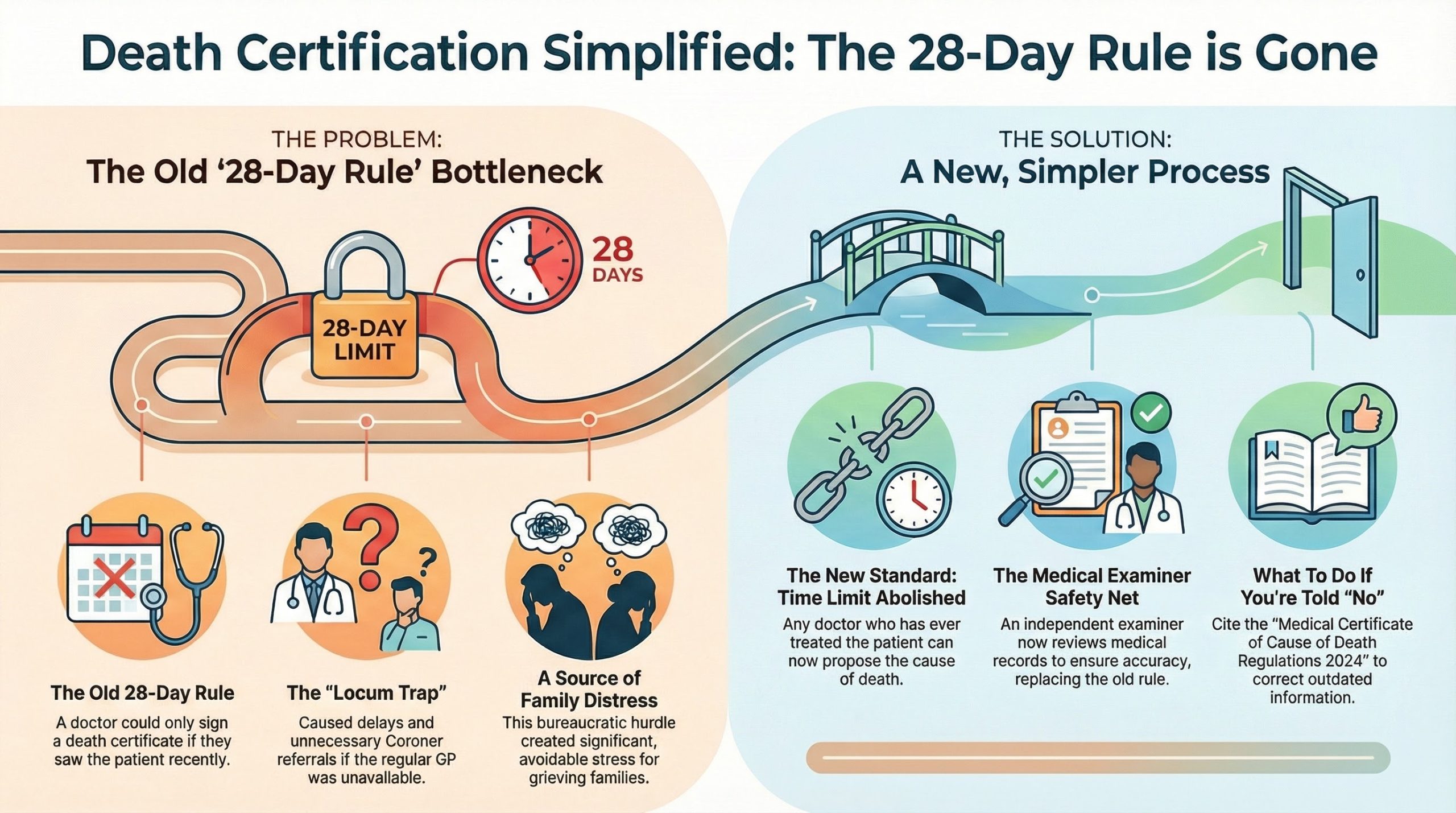
    One of the most frequent causes of distress for grieving families is being told: “The GP can’t sign the death certificate because they haven’t seen your loved one in the last 28 days.”

    For years, this was a hard legal fact. It created a “Locum Trap” where families were forced into unnecessary Coroner referrals simply because their regular doctor was on holiday or the patient hadn’t visited the surgery recently.

    As of September 9, 2024, this “28-day rule” is officially dead.

    Under the new Medical Certificate of Cause of Death Regulations 2024, the criteria for who can sign has been fundamentally redefined. This guide explains the technical shift and how it eliminates one of the biggest bottlenecks in the registration process.

    1. The Old Law vs. The New Logic

    To understand why this is a “Remarkable” shift for families, we have to look at what changed in the statutory language:

    • Pre-Sept 2024: A doctor could only sign the Medical Certificate of Cause of Death (MCCD) if they had “attended” the deceased during their last illness and had seen them either within 14 days of death (extended to 28 days during the pandemic) or after death.
    • Post-Sept 2024: The requirement to have seen the patient within a specific timeframe (14 or 28 days) has been abolished.

    The new legal standard is simply that the doctor must be an “Attending Practitioner” (AP)—defined as any GMC-registered doctor who attended the deceased during their lifetime.

    2. Why This Matters: The End of “The Locum Delay”

    Previously, if your parent passed away at home and their specific GP was away, the surgery would often say, “No other doctor can sign because they haven’t seen the patient recently. This must go to the Coroner.”

    This triggered a “Defensive Medicine” loop. Coroners were being flooded with natural, expected deaths simply because of a calendar technicality.

    The New Reality: If any doctor in the practice has treated the patient for their condition at any point in the past, they are now legally empowered to propose a cause of death. They do not need to have seen the patient in the final weeks, provided they can identify a probable cause of death from the medical records.

    3. The Role of “Independent Scrutiny”

    You might wonder: If a doctor hasn’t seen the patient for months, isn’t it dangerous for them to sign?

    This is why the Medical Examiner (ME) system was introduced. The new law shifts the burden of “accuracy” from the calendar to the Medical Examiner.

    1. The Attending Practitioner proposes the cause based on their knowledge of the patient’s history.
    2. The Medical Examiner reviews the full medical record to ensure that cause makes clinical sense.
    3. This double-check allows for flexibility in who signs without compromising the safety of the system.

    4. What to do if you are told “The GP can’t sign”

    If you find yourself in a surgery or hospital where staff are citing the “28-day rule,” you are likely dealing with “Legacy Knowledge.” Here is your technical script to resolve the situation:

    • The Citation: “Under the Medical Certificate of Cause of Death Regulations 2024, the requirement for a doctor to have seen the patient within 28 days has been removed.”
    • The Request: “Can you please check if there is any ‘Attending Practitioner’ in the practice who has treated [Name] during their lifetime? They are now authorized to propose a cause to the Medical Examiner.”
    • The Outcome: This usually prompts the surgery to contact their local Medical Examiner’s office, who will confirm the new rules and help the GP process the paperwork.

    5. Frequently Asked Questions (FAQ)

    Q: What if NO doctor at the surgery ever saw the patient? A: If no doctor attended the patient during their lifetime (e.g., they just moved to the area), then the death must still be referred to the Coroner. However, this is now a rare edge case.

    Q: Does the doctor still need to see the body after death? A: No. There is no longer a statutory requirement for a doctor to physically “verify” or “view” the body for the purposes of the MCCD, as the Medical Examiner provides the independent check of the records.

    Q: Will this make the process faster? A: Yes. By removing the “28-day bottleneck,” more doctors are available to start the paperwork, preventing cases from being unnecessarily stuck in the Coroner’s queue.

    Expert Summary

    The “28-day rule” was a blunt instrument that caused thousands of families to suffer through unnecessary inquests. Its removal is a victory for common sense and “Unreasonable Hospitality” in the death registration process.

    As an Executor, you no longer need to panic if your loved one’s doctor is on leave. The law now prioritizes clinical knowledge over calendar dates.

    Next Step: Once the Attending Practitioner proposes the cause, the next milestone is the Medical Examiner Officer (MEO) call. Use our 72-Hour Limbo Checker to track how your case is moving through this new, simplified relay.

  • Abolition of Cremation Form 4: How the Sept 2024 Rules Just Saved You £82

    For decades, families in England and Wales choosing cremation for a loved one were hit with a “hidden tax” that few understood and even fewer could avoid. It was known colloquially in the medical profession as “ash cash,” but officially, it was the fee for Cremation Form 4.

    As of September 9, 2024, this fee—and the bureaucratic hurdle that accompanied it—has been legally abolished.

    This guide explains why this form existed, how the new Medical Examiner system replaces it, and why this represents one of the most significant “Unreasonable Hospitality” shifts in modern UK bereavement law.

    1. What was Cremation Form 4?

    Under the old regulations, the law required an extra layer of protection for cremations because, unlike a burial, the body cannot be exhumed later if concerns are raised.

    This resulted in a two-doctor requirement:

    1. Doctor 1 (Form 4): The attending doctor who certified the death.
    2. Doctor 2 (Form 5): A second, independent doctor who had to “confirm” the findings of the first.

    The second doctor charged a fee for this service—typically £82.00 (the British Medical Association’s recommended rate). This was paid by the family, usually via the funeral director’s disbursements.

    2. The Sept 2024 Pivot: Statutory Scrutiny

    The Cremation (England and Wales) (Amendment) Regulations 2024 changed the logic of death certification.

    Instead of paying a second doctor for a “confirmatory” signature, every death (whether for burial or cremation) now undergoes mandatory scrutiny by a Medical Examiner (ME). Because the ME is an independent, senior doctor provided by the NHS, their review serves the same protective purpose as the old Form 5, but without the additional cost to the family.

    The Result: The need for a second doctor to sign off on a cremation is gone.

    3. The Financial Impact: Where is the £82?

    If you are looking at a funeral quote today, you should no longer see a line item for “Cremation Medical Fees” or “Doctor’s Fees.”

    • Pre-Sept 2024: Total medical fees for cremation were often £164 (Two doctors at £82 each, though the first doctor’s fee was abolished earlier for some).
    • Post-Sept 2024: The fee is £0.

    Expert Tip for Executors: If a funeral director includes “Doctors’ Fees” for cremation in their quote, they may be using an outdated template. Under the new regulations, there is no statutory basis for charging a family for the medical certification of a cremation in England and Wales.

    4. Why This is Better for Families (The Scrutiny Benefit)

    Beyond the financial saving, the abolition of Form 4 removes a major “friction point” in the bereavement timeline.

    In the old system, finding a “second doctor” often caused delays, especially on weekends or bank holidays. The new National Medical Examiner System is centralized and integrated into the hospital or community workflow.

    This means:

    • Faster Turnaround: The scrutiny happens as part of the standard certification process.
    • Unified Logic: One office (the Medical Examiner’s) handles the paperwork for both the Registrar and the Crematorium.
    • Higher Standard of Care: The ME review is more thorough than the old “second doctor” confirmatory check, providing greater peace of mind that the cause of death is accurate.

    5. Frequently Asked Questions (FAQ)

    Q: Does this apply to burials too? A: No, because burials never required the “second doctor” fee. However, burials do now require Medical Examiner scrutiny, which ensures the same level of accuracy in death certification across the board.

    Q: Are there any medical fees left? A: For deaths in England and Wales, there are no longer fees for the standard medical certification of death for cremation. The only remaining medical fees might relate to the removal of pacemakers or other implants required by the crematorium, which requires a small procedure.

    Q: What if the death occurred in Scotland or NI? A: This specific reform applies to England and Wales. Scotland has its own established review system for death certification which differs in its fee structure.

    Expert Summary

    The abolition of Cremation Form 4 is a rare win for the consumer in a traditionally expensive industry. It removes the “ash cash” stigma and replaces it with a robust, NHS-funded safety check.

    As an Executor, your role is to ensure the estate benefits from this saving. Verify your funeral invoices and ensure you aren’t paying for a “confirmatory certificate” that no longer exists in law.

    Next Step: Understanding the new timeline is crucial. Now that the “second doctor” is out of the way, your main focus should be the Medical Examiner Officer (MEO) call. Use our 72-Hour Limbo Checker to see how quickly your paperwork is likely to move through the new system.

  • The Medical Examiner Officer (MEO) Call: What They Will Ask and Why You Can’t Skip It

    In the first few days following a bereavement, your phone will ring with a call from someone you likely haven’t heard of: the Medical Examiner Officer (MEO).

    Under the old system (pre-September 2024), this role didn’t exist for most people. Today, this phone call is a mandatory statutory milestone. If you miss it, or if the conversation isn’t completed to the MEO’s satisfaction, the entire death registration process stops.

    This guide explains the technical logic behind the call, what questions you will be asked, and how to handle it with the “Remarkable” poise required of a modern Executor.

    1. Why is this call happening? (The Sept 2024 Rule)

    The Medical Certificate of Cause of Death Regulations 2024 mandates that every death not investigated by a Coroner must be scrutinized by a Medical Examiner.

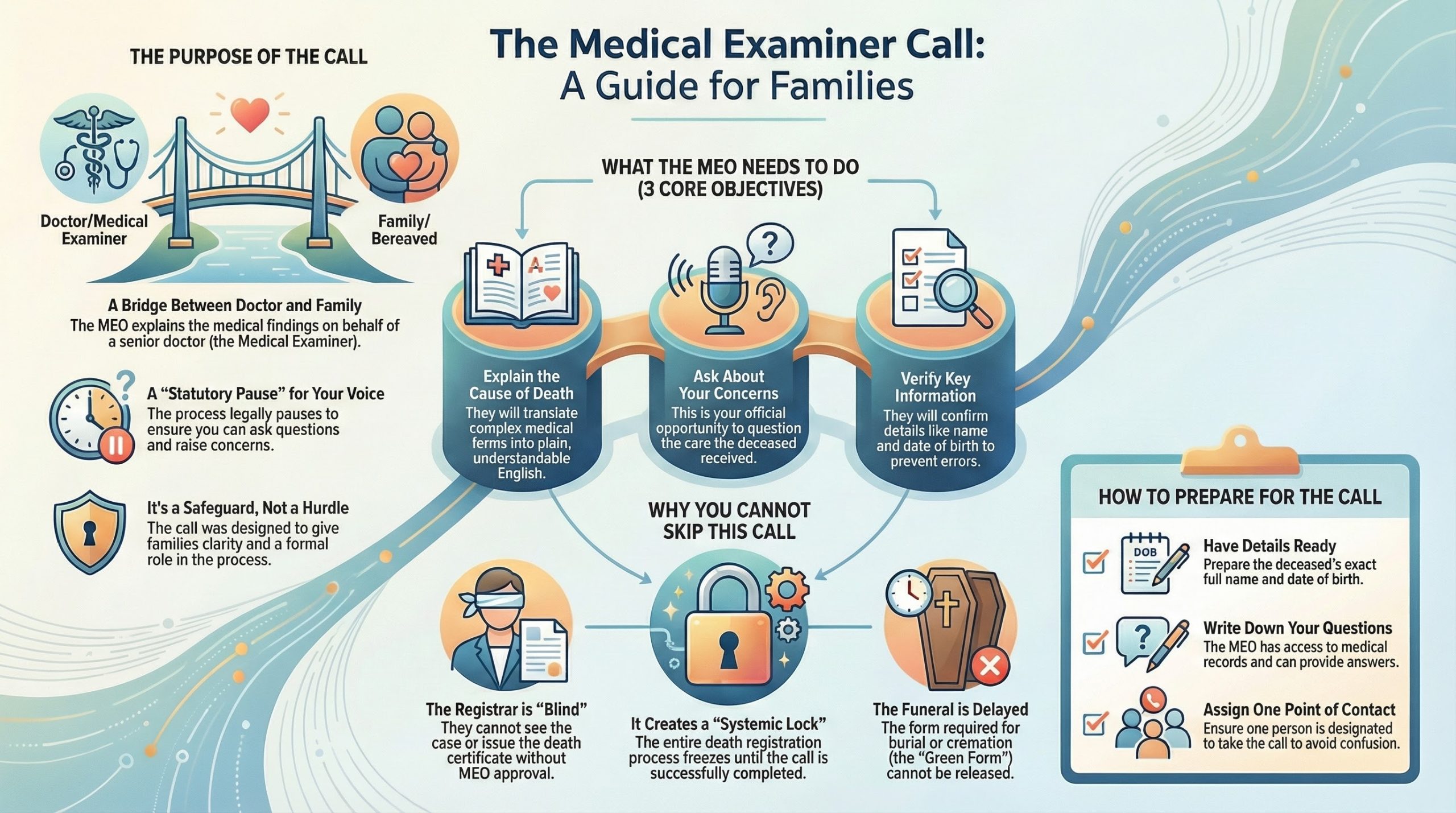
    The Medical Examiner (ME) is a senior doctor who didn’t treat the patient but is reviewing the case for accuracy. The MEO is their primary officer. Their job is to act as a bridge between the clinical review and you—the family.

    The Statutory “Pause”: The Medical Examiner cannot authorize the Registrar to issue a death certificate until the MEO has spoken with the Next of Kin. This is designed to ensure that the family’s voice is heard before the legal cause of death is finalized.

    2. The Three Core Objectives of the Call

    When the MEO calls, they are looking to check three specific boxes required by law:

    1. Explanation: They will explain the medical cause of death in plain English, moving away from the complex Latin or clinical jargon found on the draft certificate.
    2. Concerns: They will ask if you have any concerns about the care the deceased received or the circumstances leading up to the death.
    3. Accuracy: They will verify that the information the doctor has provided (such as name, date of birth, and occupation) is correct to prevent errors on the final certificate.

    3. What the MEO Will Ask You

    The call typically lasts between 10 and 20 minutes. You should be prepared for the following questions:

    • “Did you have any concerns about the medical care provided?” This is your opportunity to raise any issues. If you raise a serious concern, the MEO may refer the case for further scrutiny or to the Coroner.
    • “Is the proposed cause of death what you expected?” They will read out the cause (e.g., 1a. Ischaemic Heart Disease). They want to ensure this aligns with your understanding of the deceased’s health.
    • “Are there any religious or cultural requirements for the funeral?” They need to know if you require an urgent burial (e.g., for Jewish or Muslim faiths) so they can prioritize the scrutiny.
    • “Who is your chosen Funeral Director?” While not a legal requirement for the certificate, they often use this to coordinate the movement of the body once the scrutiny is complete.

    4. Why You Can’t “Skip” the Call

    We have seen families try to avoid this call because they are overwhelmed. However, avoiding the MEO creates a “Systemic Lock”:

    • The Registrar is Blind: Until the MEO marks the case as “Scrutiny Complete” in the national digital system, the Registrar cannot see the death on their computer.
    • The 5-Day Rule: The “5-day clock” for registration effectively begins after this call is successful.
    • The Funeral Delay: Without the MEO’s authorization, the “Green Form” (certificate for burial or cremation) cannot be issued, meaning the funeral cannot proceed.

    5. How to Prepare (The “Unreasonable Hospitality” Strategy)

    At EstateOS, we believe in anticipating hurdles. To make this call as smooth as possible:

    1. Have the Full Name and DOB Ready: Ensure you have the exact spelling and details as they appear on a passport or birth certificate.
    2. Write Down Questions: If you didn’t understand why a certain medication was given or why a certain symptom occurred in the final hours, the MEO is the best person to ask. They have access to the medical records that you do not.
    3. Assign a Single Point of Contact: Ensure the hospital or GP has the phone number of the one person who will handle this call to avoid conflicting messages.

    Expert Summary

    The MEO call is a safeguard, not a hurdle. It was introduced to ensure that the “Family Voice” is part of the legal record of death. Treat this call as your primary opportunity to get clarity on the medical side of your loved one’s passing.

    Next Step: If you haven’t received a call within 48 hours of the death, use our Medical Examiner Predictor to find the contact details for your local ME office. Don’t wait for the system to find you; take control of the timeline.

  • The 2024 Death Registration Trap: Why the Old Rules No Longer Apply

    The 2024 Death Registration Trap: Why the Old Rules No Longer Apply

    For over half a century, the process of registering a death in England and Wales was a predictable, two-step relay: the GP signed a certificate, and the family took it to the Registrar. On September 9, 2024, that legacy system was dismantled.

    If you are navigating a bereavement today based on advice from a friend who went through it even six months ago—or if you are following outdated brochures still found in many hospital waiting rooms—you are likely heading for “The Registration Trap.” This guide breaks down the technical logic of the National Medical Examiner System to help you navigate the first 72 hours without the stress of systemic delays.

    EstateOS | 72-Hour Limbo Checker

    Limbo Risk Checker

    SEPT 2024 REGS

    1. Was the death expected?

    1. The Conflict: The 5-Day Statutory Target vs. The Scrutiny Reality

    The Births and Deaths Registration Act 1953 technically still mandates that a death must be registered within five days. However, the Medical Certificate of Cause of Death Regulations 2024 has introduced a mandatory “Scrutiny Phase” that makes this window extremely difficult to hit.

    The Major Shift: Under the old system, the “5-day clock” started the moment the person died. Under the new statutory system, the clock effectively pauses until the Medical Examiner (ME) has completed their independent scrutiny and electronically notified the Registrar.

    The “Limbo” Period: Families are frequently finding themselves in a state of administrative limbo—unable to book a funeral, unable to obtain a death certificate, and often receiving conflicting information from GPs and Hospital Bereavement Offices who are still adjusting to the new digital workflow.

    2. The New Workflow: The Three-Stage Relay

    To outpace the delays, you must understand the technical logic of how your paperwork now moves. It is no longer a physical document you carry; it is a digital baton passed through three distinct stages:

    Stage 1: The Attending Practitioner (AP)

    The 2024 rules have significantly broadened who can propose a cause of death. Previously, a doctor had to have seen the patient within 28 days of death. Now, any doctor who attended the deceased during their lifetime (the “Attending Practitioner”) can propose the cause. This change was designed to prevent delays when a specific GP is on holiday or unavailable.

    Stage 2: The Medical Examiner (ME) Scrutiny

    Once the AP proposes a cause, the case is referred to a Medical Examiner—a senior, independent doctor. They review the medical records to ensure the cause of death is accurate and that there are no “red flags” that require a referral to the Coroner. This is not just a “rubber-stamping” exercise; it is a legal safeguard introduced following the Shipman Inquiry.

    Stage 3: The Family Discussion (The MEO)

    This is the most critical change for families. You will be contacted by a Medical Examiner Officer (MEO). This conversation is a statutory requirement. They will explain the medical cause of death in plain English and ask if you have any concerns about the care provided.

    • Crucial Note: You cannot register the death until this conversation has taken place and the ME has electronically authorized the Registrar.

    3. The “Cremation Form” Revolution: Financial Impacts

    For Executors, one of the few positive changes is the abolition of Cremation Form 4.

    In the old system, if a loved one was being cremated, a second, independent doctor had to be paid a fee (often around £82) to sign a confirmatory certificate. As of September 2024, the Medical Examiner’s scrutiny replaces the need for this second doctor and the associated fee. If a GP surgery or hospital asks you for a “Cremation Fee” for paperwork, they are operating under outdated (and now illegal) protocols.

    4. How to Avoid “The Trap”: Expert Action Plan

    To manage the “Unreasonable Hospitality” of this process—anticipating the hurdles before they trip you up—follow this authority-backed checklist:

    • Wait to Book the Funeral: Do not set a firm date with a Funeral Director until the Medical Examiner’s office confirms the Medical Certificate of Cause of Death (MCCD) has been transmitted to the Register Office. Booking early is the #1 cause of unnecessary family stress.
    • Identify your MEO: When speaking with the hospital or GP, ask: “Who is the Medical Examiner Officer assigned to this case?” Having a direct name and extension for the MEO is the only way to get a real-time status update.
    • The “Hand-Carried” Myth: Registrars no longer accept paper MCCDs handed over by the family. The document must be sent via a secure digital link. If you show up at the Register Office with a paper form given to you by a doctor, you will likely be turned away.
    • Coroner Referrals: If the death was “unexpected,” the Medical Examiner will likely refer the case to the Coroner. This overrides the standard timeline and may result in an “Interim Death Certificate.”

    5. Frequently Asked Questions (FAQ)

    Q: Does every death go to the Medical Examiner? A: Yes. Every death in England and Wales that is not immediately referred to the Coroner must now be scrutinized by the Medical Examiner’s office.

    Q: What happens if I disagree with the cause of death? A: This is why the MEO call exists. You have a legal right to voice your concerns during the scrutiny phase. The ME can then investigate further or refer the case to the Coroner if the cause is unclear.

    Q: Can I register the death in a different district? A: You can “register by declaration” at any register office in England and Wales, but the information will be sent to the office in the district where the death occurred. This can add a few days to the process.

    Expert Summary for Executors

    The 2024 reforms were designed to provide safety, but they have fundamentally changed the “rhythm” of bereavement. The traditional 5-day window is now a target, not a guarantee. Understanding that the delay is a statutory scrutiny requirement—rather than an administrative error—is essential for managing family expectations.

    Don’t wait in the dark. Use our Medical Examiner Predictor to see if your specific circumstances (location of death, attending physician status, etc.) are likely to result in a 72-hour or 14-day window. Knowledge is the only way to close the “Limbo” gap.